
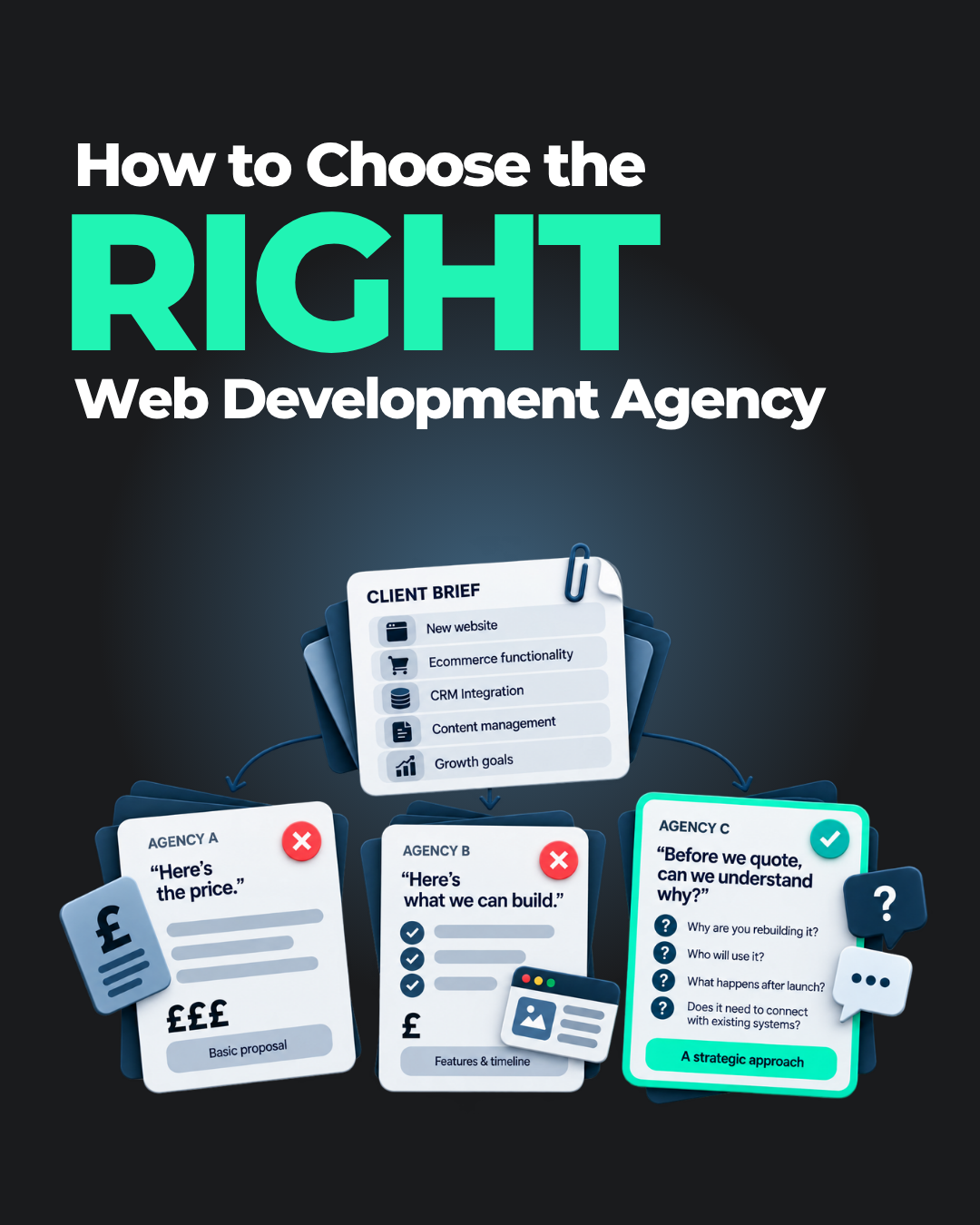
You send the same website brief to three web development agencies.
The first replies quickly with a surprisingly low quote. The second sends across a polished proposal filled with impressive terminology, timelines and a long list of features. The third takes a little longer and, instead of immediately telling you what they can build, starts asking questions.
What is the website actually meant to achieve? Who will use it? What happens after someone submits an enquiry? Who will manage the website once it is live? Does it need to connect with any existing systems? Why are you rebuilding it in the first place?
At first, those questions can feel like unnecessary complication. You asked for a website, not a business consultation.
But they may tell you more about the agency than the proposal itself.
Choosing the right web development agency is not simply about finding a company that can build a website. Plenty of companies can do that. The more important question is whether they can build the right website for your business — and whether they understand enough about your goals, customers and operations to make good decisions along the way.
That is why choosing a website development company purely on portfolio, technology or price can be misleading. A beautiful website can still be difficult to use. An impressive technical solution can be unnecessarily complex. And a cheap quote can represent excellent value — or simply leave out half of what you thought you were buying.
So, how do you choose a web development agency that is actually right for your business?
A useful way to evaluate your options is the RIGHT framework:
R — Requirements
I — Insight
G — Governance
H — Handover
T — Transparency
These five areas help you look beyond attractive portfolios and headline prices to understand how an agency thinks, how it works and what it will actually be like to build a website with them.
R — Requirements: Does the Web Development Agency Understand What You Need?
A good website project starts before anyone opens a design tool or writes a line of code. It starts with understanding the problem.
You may already have a detailed brief. You may know that you want a new ecommerce website, a customer portal or a complete redesign. You may even know which platform you want to use.
That is useful, but a strong web development agency should still want to understand what sits behind those requirements.
Suppose you tell an agency that you want live chat on your website. One response would be to add live chat to the proposal and move on. Another would be to ask what customers are trying to achieve when they use it, what questions they usually ask, who will respond to those enquiries, whether your team can support it throughout the day and whether some of those questions could be answered more effectively elsewhere on the website.
The first agency is responding to the feature you requested. The second is trying to understand the problem the feature is meant to solve. That distinction matters because businesses often approach website projects with solutions already in mind.
“We need Shopify.”
“We need AI.”
“We need a customer portal.”
“We need to redesign the homepage.”
Sometimes those decisions are absolutely right. But sometimes the real problem is somewhere else.
A conversion issue may actually be a content issue. A navigation problem may not require an entire redesign. A request for new technology may be better solved by improving an existing process. A new feature may add complexity without creating any meaningful value for the customer.
The agency does not need to challenge every request for the sake of it. What you are looking for is evidence that the solution follows the requirement, rather than the other way around.
Pay close attention to the questions an agency asks before it provides a quote. They often reveal how deeply the team is trying to understand your business and whether they are thinking beyond the immediate build.
I — Insight: Can They Bring Thinking as Well as Execution?
A portfolio is usually one of the first things businesses look at when choosing a web development agency, and that makes sense. You want to know whether the team can produce work of a good standard.
But there is a danger in judging an agency purely on whether you like how its websites look. Websites are not posters. They have jobs to do.
A visually impressive homepage may still fail to tell people what the business actually offers. A beautiful ecommerce store may make products difficult to find. A minimalist interface can look sophisticated while making users work far too hard to understand what they should do next.
When you review an agency’s previous work, try to understand the thinking behind it.
Why was the website structured the way it was? How did the agency decide what information belonged on the homepage? What did it do to make the customer journey easier? Why was a particular platform chosen? How did the solution accommodate the client’s internal team? Were there integrations or operational requirements that shaped the build?
Even when detailed project data is confidential, a strong web development partner should usually be able to explain the reasoning behind its decisions. That ability matters because web development rarely exists in isolation.
A website touches content, design, user experience, search, analytics, performance, accessibility, marketing and sometimes internal business systems. Not every project needs a complex strategy covering all of those areas, but the agency should understand how they affect one another.
There is little value in driving more traffic to a website if the landing experience is confusing. There is little value in creating a beautifully designed content hub if the internal team cannot easily update it. And there is little value in adding new functionality if it makes the website slower, harder to use or more difficult to maintain.
The best agency for your project is therefore not necessarily the one that says yes to the most things. It may be the one that can explain why some things are worth doing and others are not.
G — Governance: Is There a Clear Web Development Process?
Good ideas are only useful if the project can actually deliver them. Website projects have a habit of becoming complicated.
A new stakeholder joins halfway through and has a different opinion. Content arrives later than expected. Someone assumes a feature is included when it was never discussed. Feedback gets spread across email, WhatsApp, meetings and comments in design files. A seemingly small change begins to affect three other parts of the website.
This does not necessarily mean something has gone badly wrong. It is simply what happens when multiple people, decisions and dependencies are involved.
That is why project governance matters. Before choosing a web development agency, understand how it plans to manage the work from discovery through design, development, testing and launch.
Who will be your main point of contact? How will feedback be collected? How many revision stages are included? When will you be expected to review designs? What happens if a new requirement appears halfway through the project? How are changes to the agreed scope handled?
You should also understand what the agency expects from you.
Website projects are collaborative. If your team needs to supply product information, imagery, website copy or approvals by certain dates, that needs to be clear. An agency cannot manage a timeline effectively if key inputs arrive unpredictably.
The goal is not to find an agency with the most complicated project-management methodology. In fact, too much process can become a problem of its own. What matters is that the project feels controlled.
Everyone should know what has been agreed, what is happening now, what happens next and who is responsible for moving it forward. A clear web development process does more than protect the timeline. It also protects the quality of the work because decisions are made deliberately rather than rushed through at the end.
H — Handover: What Happens After the Website Goes Live?
Launch day gets a lot of attention.
It is exciting. Months of planning, designing, writing and development finally become something real. But for the business, launch is the beginning of using the website, not the end of the project.
Someone will need to update content. Products may need changing. New team members will need access. Software will need maintaining. Integrations may need attention. Campaigns may require new landing pages. A form will eventually need changing. Something, at some point, will need fixing.
That is why website development should not end with someone sending you a message saying, “Your site is live.” Before appointing an agency, understand what handover, website maintenance and post-launch support actually look like.
Will your team receive training? Will you have the access you need to manage the website? Is documentation included? Who owns the hosting account, domain, licences and third-party services? If the agency provides ongoing support, what exactly does that cover?
You should also ask how easy the website will be for your own team to manage. This is an area where the most technically impressive solution is not necessarily the best one.
A complex architecture may offer enormous flexibility, but if your marketing team needs developer support every time it wants to change a banner, publish a page or update an image, that flexibility may not be particularly useful in practice.
The right solution should reflect the reality of the organisation using it. If you have an experienced digital team, that may justify more complexity. If the website will be managed by one person who also has five other responsibilities, ease of use may matter much more.
A good web development agency thinks about both audiences: the people visiting the website and the people responsible for running it.
T — Transparency: Do You Understand Exactly What You Are Buying?
Eventually, every agency selection reaches the question of price.
And price matters.
Every business has a budget, and there is nothing wrong with comparing web development quotes carefully. The problem begins when price becomes the only thing that is compared. Two website quotes can look like they are pricing the same project when, in reality, they are offering very different things.
One proposal may include discovery, information architecture, UX design, bespoke interface design, responsive development, integrations, analytics configuration, testing, content migration, training and post-launch support.
Another may include the development of ten pages using an existing template. Both may result in something called “a website”.
They are not the same scope.
That is why a significantly cheaper quote should not automatically be treated as a bargain, just as a more expensive quote should not automatically be treated as better.
The more useful question is:
What am I actually getting for each price?
Look carefully at what is included, what is excluded and what could incur additional cost later.
Does the price include responsive design for mobile and tablet? Who is responsible for the content? Is content migration included? What happens if you need additional pages? Are third-party licences included? How many revision rounds are available? Is testing part of the scope? What kind of support is provided after launch?
The more transparent the proposal, the easier it becomes to compare value properly.
You should also pay attention to how the agency discusses budget. A good partner should be able to explain where the money is going and, where necessary, help you prioritise.
Perhaps everything on the original wishlist cannot fit into phase one. That does not necessarily mean the project has failed before it begins. It may simply mean identifying which functionality creates the most value now and which can be introduced later.
That is a much healthier conversation than quietly reducing quality or removing important work simply to meet a number.
Questions to Ask a Web Development Agency Before You Hire Them
The RIGHT framework gives you a useful way to compare agencies, but it also helps to go into your conversations with a few practical questions.
Before signing with a web development company, consider asking:
- What do you need to understand about our business before recommending a solution?
- Who will actually be working on our project?
- What does your web development process look like?
- How will feedback and revisions be handled?
- How do you manage changes to the agreed scope?
- What will you need from our team during the project?
- How do you approach mobile usability and website performance?
- How do you consider accessibility and search visibility during development?
- What testing happens before the website goes live?
- Will our team be able to update the website ourselves?
- Will we receive training or documentation?
- Who owns the website, hosting accounts, licences and other services after launch?
- What ongoing website support and maintenance do you provide?
- What exactly is included in the quote?
- What could result in additional costs?
- How will we know whether the new website is successful?
You are not looking for a perfect scripted answer to every question.
What matters is whether the agency can explain its approach clearly, whether its recommendations make sense for your business and whether there are any major assumptions hiding inside the proposal.
The RIGHT Framework Only Works if the Relationship Feels Right Too
Requirements, Insight, Governance, Handover and Transparency give you a practical way to compare web development agencies, but there is one thing that is harder to capture in a spreadsheet: the working relationship.
A website project may last weeks or months. During that time there will be feedback, decisions, changes of direction and moments when something does not work exactly as expected.
You need to be able to communicate with the people on the other side.
Notice what happens before the contract is signed.
Does the agency listen carefully, or does every conversation return to what it wants to sell? Does the team explain technical decisions in language you can understand? Are they comfortable telling you when something may not be worth the investment? Do they ask questions when something is unclear? Are they honest about limitations?
You do not need the agency to agree with every idea you have.
In fact, an agency that agrees with absolutely everything may not always be giving you the advice you need.
What you want is a team that can challenge ideas constructively, explain its reasoning and still respect that the final decisions belong to the business.
The strongest client-agency relationships tend to feel less like placing an order and more like solving a problem together.
How Do You Choose the Best Web Development Agency for Your Business?
There is no single best web development agency for every organisation.
A small brochure website does not need the same team, process or technical capability as a multi-market ecommerce platform. A start-up launching its first website may have very different priorities from an established company replacing a business-critical digital platform.
That is why the question should not simply be:
“Who is the best web development agency?”
It should be:
“Who is the right web development agency for this business, this website and this stage of growth?”
The RIGHT framework gives you a practical way to answer that question.
Does the agency understand your Requirements, rather than jumping straight to a solution?
Does it bring Insight and explain the thinking behind its recommendations?
Is there enough Governance to keep the project structured and collaborative?
Has the agency planned for Handover, support and the day-to-day reality of managing the website?
And is it Transparent about scope, pricing, responsibilities and limitations?
If the answers to those questions give you confidence, you are already looking beyond the things that make agencies easy to compare — portfolios, platforms and prices — and towards the things that are much more likely to determine whether the project works.
Before making the final decision, there is one last question worth asking:
Do we trust this team to make good decisions when the answer is not obvious?
Because building pages is only one part of web development.
The real value of the right web development partner is helping you decide what should be built, how it should work and why it matters to your business.
Frequently Asked Questions
How do I choose a web development agency?
Start by looking at more than the agency’s portfolio or price. Consider how well it understands your requirements, whether it can explain the thinking behind its recommendations, how it manages website projects, what happens after launch and how transparent it is about scope and cost. The right agency should fit both the technical needs of the project and the way your business needs to work.
What should I look for in a web development company?
Look for relevant experience, strong problem-solving skills, a clear web development process, good communication and transparency around pricing. It is also important to understand how the agency approaches user experience, responsive design, performance, testing, handover and ongoing website support.
How should I compare web development quotes?
Do not compare only the total cost. Compare the scope behind each quote. Check whether strategy, UX and design, development, responsive behaviour, integrations, testing, content migration, training, maintenance and post-launch support are included. Two proposals that both promise “a website” may contain very different amounts of work.
Should I choose the cheapest web development agency?
Not necessarily. A lower quote may represent excellent value, but it may also include a smaller scope or fewer services. Equally, a higher price does not automatically mean a better website. The important thing is to understand exactly what each agency is providing and whether it matches what your business actually needs.
What questions should I ask a web development agency?
Ask how the agency determines requirements, who will work on your project, how its development process works, how feedback and scope changes are managed, what testing is included, how your team will manage the site after launch and what ongoing support is available. You should also ask for a clear explanation of what is and is not included in the quote.
How long does it take to build a website?
There is no single timeline that applies to every website. The duration depends on the size and complexity of the project, how much custom design or functionality is required, integrations, content readiness, feedback cycles and testing. A good agency should be able to explain the stages of the project and provide a realistic timeline based on your specific requirements.


